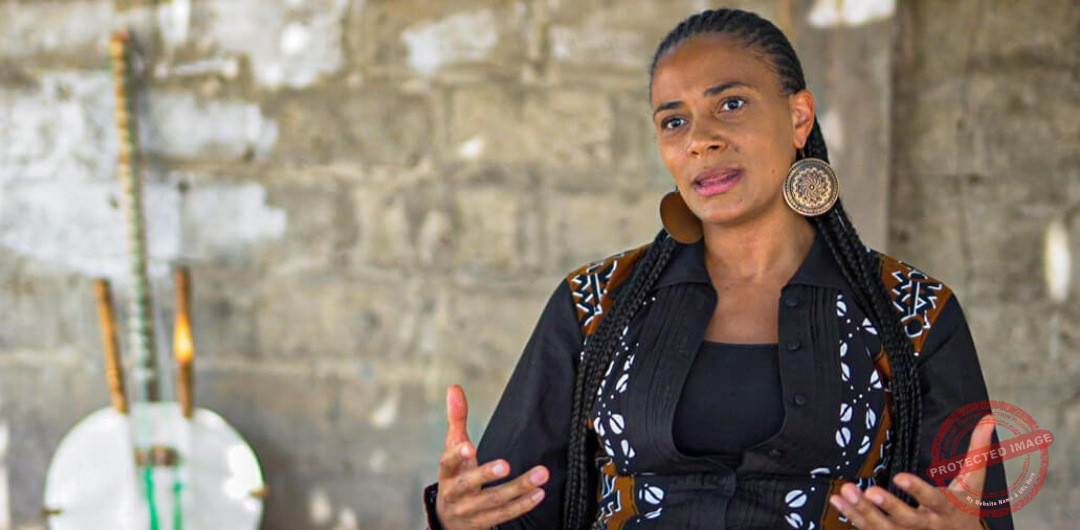


Sona’s introduction to the kora began at a very young age. Her brother started teaching her when she was still a child, and her father—himself a master of the instrument—decided to guide her with a principle that shaped her path: he would teach her not as a daughter, but as a child and as a student, expecting her to focus on being great, not on being female. That mindset stayed with her. She never set out to be the "first woman" to do it—she set out to do it well.
But finding her place in the world wasn’t immediate. Growing up between the UK and The Gambia exposed her to two contrasting cultures. Her teenage years were marked by a deep internal struggle—where did she belong? Which version of herself was true? Until the age of 17, the kora wasn’t her primary focus. She was still trying to find her footing, exploring who she was and what she was meant to do.
It was then, with clarity and intention, that she approached her father and asked to be taught seriously. Aware that she was stepping into a male-dominated tradition, she kept her learning private until she felt ready—ready to stand confidently with her instrument, not seeking validation, but deserving it.
The turning point came during her first performance, held at Alliance Française on Kairaba Avenue. She performed alongside her father and two other family members. Despite early doubts and industry pressure to pursue more commercial or popular styles of music, Sona stayed true to her roots. She recalls saying she would rather play for ten people with honesty than for ten thousand with a music that wasn’t her own.
It was that performance—and the overwhelming support from her family—that confirmed she had chosen the right path. The emotional highlight came when she performed a song dedicated to her grandmother with her father. One by one, family members joined her on stage. That moment of acceptance wasn’t just a personal victory—it was a symbolic one.
Now, as a global artist and educator, Sona is driven by more than music. Her mission is to change how young Gambians and Africans at large view themselves through education. Nearly a decade ago, she founded The Gambia Academy, but she’s quick to clarify—this is not a music school. It’s a school that places African identity, language, and culture at the centre of every subject.
For her, true education doesn’t require students to shed their culture to succeed. On the contrary, it should empower them to embrace it. The Academy offers an alternative model where students don’t have to choose between cultural pride and academic achievement.
But transforming education is no small task. One of the biggest challenges she faces is finding teachers willing and able to adopt a completely new approach. To address this, she has invested heavily in developing a new curriculum—not just for students, but also for training educators to teach through this culturally grounded lens.
The Academy is also becoming a destination for international learners. People from around the world come to study its approach and contribute their knowledge and resources. To accommodate this growing interest, new facilities are under construction, including a student residence and an expanded campus to support diverse areas of study.
Sona’s story is also a message to women everywhere: you don’t have to fit into expectations to succeed. She hopes to inspire women not just to break stereotypes, but to reimagine how they see themselves—as musicians, leaders, educators, and changemakers.
In her words and actions, Sona reminds us that music is more than entertainment—it’s a cultural ambassador. She has refused to sing in English, choosing instead to use Mandinka as a way to strengthen cultural identity. Today, thousands of non-Gambians sing her songs in Mandinka—a quiet victory in her lifelong mission to preserve and promote heritage.
Through her music, her school, and her example, Sona Jobarteh continues to shape a generation that no longer sees education and culture as separate, but as partners in building a stronger, more rooted future.
If you would like to learn more or get involved with The Gambia Academy, reach out and be part of this transformational journey.


The Junior Department of the Academy, founded in 2015, operates as a pilot program with 36 students, preparing for its future expansion to accommodate up to 300 junior and senior students. Currently located in a temporary space near the main...
Read More


Typically replies within 30 minutes
We will be back soon.


